About our school
School Mottos
Hyogo Senior High School has 4 school mottos that the students are encouraged to follow. Those are:
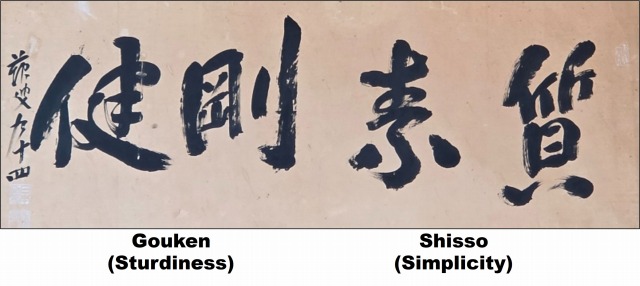
Simplicity:
Students should make a conscious effort to wear appropriate school attire, meaning that the clothes should be kept simple and basic, nothing too gaudy, to maintain equality among students. Following this ideal of simplicity, in every school activity, helps students to steadily grasp the concept of humility.
Sturdiness:
Students must have the courage and determination to follow their own beliefs and ideas, making sure that it does not lead to becoming stubborn nor conceited.
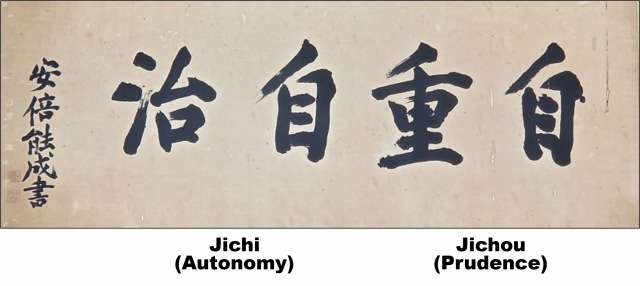
Prudence:
Students are expected not to be influenced by the current, popular trends of society but to maintain their integrity despite such pressures. Every student is expected to be modest and never arrogant, nor mean, in every school activity.
Autonomy:
As students are given more autonomy in high school, this should never lead to arrogance nor conceitedness but rather to a more modest school life. Students should remember that, even though they may have more freedom, they should never ignore any advice that is given to them.
School Emblem

The eucalyptus tree is the symbol of Hyogo High School and that is why at the center of the emblem is the nut from a eucalyptus with three eucalyptus leaves evenly spaced around it. This was designed to signify that each generation of students join together in order to pursue the ideals our school was founded upon: Simplicity, Sturdiness, Prudence and Autonomy.
School Philophies
Realizing in our daily lives the four school mottos --- “simplicity, sturdiness, prudence and autonomy”--- we aim to promote the education, the well-roundedness of each student and to foster promising youths who eventually will become the leaders of the 21st century.
- (1) To enrich the mind and to prepare the students for the real world.
- (2) To fulfill the spirit of independence and foster the ability to think on their own.
- (3) To provide guidance for career planning.
- (4) To promote health education.
- (5) To deepen ties with students’ families, school alumni, and the community.
History
Hyogo High School was established in 1948 but can trace its history back further to the time when Hyogo Prefectural Kobe No. 2 Middle School (secondary school for men under the old educational system) was founded.
Through the post-war educational reform, Hyogo Prefectural Kobe No. 2 Middle School was merged with Prefectural Kobe No. 4 Women’s School of Higher Education (secondary school for women under the old educational system), which was established in 1942 and also well-known nationally, becoming the actual Hyogo High School. More than 30,000 students have graduated from our school counting those from the above mentioned two schools of the pre-war area. Many of them have been active in various fields. Especially, it should be noted that many are also notable in art and music.
The first Principal of No.2 Middle School, Kumeichi Tsuruzaki, established the educational policies based on four spirits: Simplicity, Virility, Modesty, and Autonomy. These spirits are called “Four Creeds” and still fundamental policies of our school. Just after the establishment of No.2 Middle School, 150 eucalyptus trees were planted around the school yard. The trees from Australia grew quickly, exceeding the height of school building’s roof, and reaching 30 meters. The all-year-around light-green leafy trees, soaring to the sky, were spectacular, resulting in becoming the symbol of our school. The students of that period would study, train themselves mentally and physically, and develop their friendship under the eucalyptus trees which suit the traditions of our school. Thus, the eucalyptus trees are always mentioned in our school song, student council’s song, fight songs, and yells. Also, the school badge was designed combining leaves and fruits of the eucalyptus tree. The trees of that period cannot be seen now, but young plants were planted in 1976. These trees have been growing around the school.
During more than 100 years since the establishment, even though time has passed and the educational system has changed, the spirits: “Simplicity, Virility, Modesty, and Autonomy. Live up to these with sincerity” have been handed down from generation to generation. We have been keeping tradition and passion to live a voluntary high school life, eliminating vanity, trying to improve the essence, and aiming to be enterprising, of wide views, warm person.
Number of students enrolled (April 1,2026)
| Male | Female | Total | |
|---|---|---|---|
| First-year | 118 | 203 | 321 |
| Second-year | 130 | 187 | 317 |
| Third-year | 131 | 185 | 316 |
| Total | 379 | 575 | 954 |
Prominent Graduates
Seishi Yokomizo (1902–1981) [横溝 正史]
Seishi Yokomizo (1902–1981) was a legendary Japanese mystery writer, widely regarded as one of the founding fathers of modern Japanese detective fiction. A proud graduate of Hyogo Prefectural Hyogo High School (then known as Kobe Second Middle School), he was born in Kobe and developed a passion for Western detective literature in his youth before embarking on a distinguished literary career.
Yokomizo is best known for creating Kosuke Kindaichi, an eccentric, shabbily dressed, but brilliant private investigator who appears in dozens of his works. His most celebrated novels—including The Inugami Curse (Inugamike no Ichizoku), The Honjin Murders (Honjin Satsujin Jiken), and Village of Eight Graves (Yatsuhakamura)—masterfully blend classic locked-room mystery logic with gothic horror, atmospheric rural Japanese folklore, and dark psychological intrigue.
Throughout his career, Yokomizo revitalized Japanese mystery fiction in the post-WWII era. His iconic stories have been adapted into numerous blockbuster films, television series, and manga, solidifying his enduring legacy as a master of suspense and atmosphere in Japanese popular culture.
Higashiyama Kaii (1908-1999) [東山 魁夷]
Higashiyama Kaii, a master in Japanese-style painting, has been recognized as a great artist throughout Japan. He spent 15 years from the age of 3 to 18 in Kobe. During his days at the Second Kobe Middle School, thanks to his teacher’s advice, he decided to become a painter. He went on to study Japanese-style painting at the Tokyo School of Fine Arts (now known as Tokyo National University of Fine Arts and Music). His work ‘Zansho’(Afterglow) introduced after the war won the Special Award at a Japanese Art Exhibition. Thereafter he painted his masterpieces one after another and built up a solid reputation in Japan and abroad as well. Most of his works are landscape paintings depicting peace, tranquility, and clearness; familiar to all Japanese. He was awarded the Order of Cultural Merit in 1969.
Koiso Ryohei (1903-1988) [小磯 良平]
Koiso Ryohei was a master in Western-style painting during the Showa era. His graceful and brilliant works, supported by his ability to catch the essence of his objects, have continued to fascinate us all till this day. Koiso was born and raised in Kobe, an international city where Japanese and Western culture were blended together. He attended the Second Kobe Middle School, at which time he met his lifelong friend, *Takenaka Iku. While only a student at the Tokyo School of Fine Arts, he received the Special Award for ‘T-jo No Zo’ (Portrait of Miss T) in the Imperial Art Exhibition. After his further studies in France, he introduced his own realistic style of paintings to Japan. He was awarded the Order of Cultural Merit in 1983. *1904-1982. He grew up to be an outstanding poet of modernism.
Shimada Akira (1901-1945) [島田 叡]
Shimada Akira was the last governor of Okinawa Prefecture appointed by the Japanese Empire. He undertook the duty just before the U.S. invasion of Okinawa. Shimada worked devotedly for the survival of his people, and consequently died because of it. Though his life in Okinawa was less than half a year, his devotion to his people was such that he has been adored as the Guardian of Okinawa. In memory of him and the war, ‘Shimamori No To’ (Tower of Guardian) was built in Mabuni, where numerous people were killed in the war. As a student of the Second Kobe Middle School, Shimada was an excellent baseball player. On that note, Hyogo Senior High School awards its students in the areas of outstanding extra-curricular activities, the Shimada-Prize, named in honor of him.
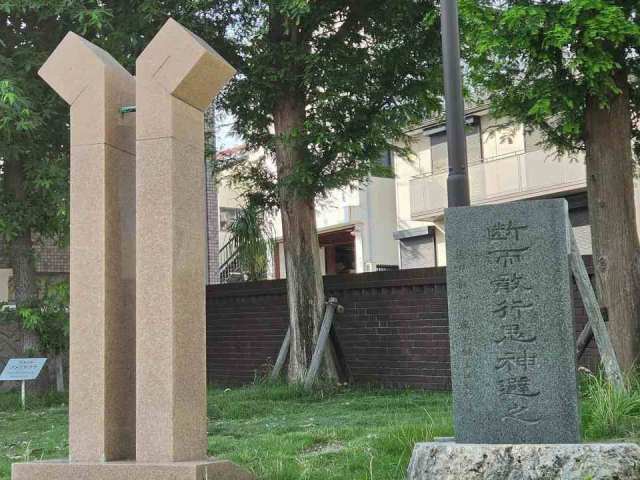
Gassho No Hi (Monument of Prayer)
This monument was built on the school grounds in honor of Shimada Akira, with his hands held together in prayer. It faces southwest because it prays for the peace of Okinawa.