Himeji Commercial High School Information Science Department Official school website
Information Science Department. An illustration of the fun of creating characters, 3D works, music and videos together with friends

HIMEJI COMMERCIAL HIGH SCHOOL

What you love becomes the power that moves the future.

Create with information technology. Deliver value with a business perspective.

Studying information science begins the moment you meet something you love and ask, "Why?" and "How would I do it?"

  • Why does a game move exactly the way we want?
  • How is AI able to answer our questions?
  • Could I turn my own idea into an app or a work of my own?
OPEN HIGH SCHOOL Event information Come and try Information Science
Illustrative image

AI, games, apps, robots, 3D fabrication, music, design. The Information Science Department starts from everyday interests and questions, teaches how information technology works, and helps students turn their ideas into reality and deliver them to people and society.

This is about much more than operating a computer. Students write programs, make machines move, analyze data, and create works and services. By thinking about why something did not work and improving it with classmates, they develop the ability to find and solve problems.

On top of that, students take subjects unique to a commercial high school, such as bookkeeping, accounting, cost accounting and business. The "power to create" through information technology, and the "power to deliver value" through business studies: gaining both is what makes the Information Science Department at Himeji Commercial High School distinctive.

Fields of study IT · Engineering · Business Across three fields
Starting point Passion → Question From "Why?" to inquiry
Hands-on cycle Prototype → Improve Turning failure into understanding
Three-year goal Delivering to society Works, products, research, careers
LEARNING BY MAKING

Understanding the world by making things.

We don't just memorize knowledge and then practice it. Because students try things with their own hands, they can see why something doesn't work, and how technology works becomes their own understanding.

  1. 01MakeGive an idea shape first
  2. 02RunCheck the real result
  3. 03FailNotice the gap between prediction and result
  4. 04Find the causeRead the data and the mechanism
  5. 05ImproveTry another way to get closer
  6. 06UnderstandExperience becomes your own understanding

Hands-on work reveals the society of the future. Working with your hands is itself a way of thinking.

01 / DEPARTMENT

Learning that combines IT, engineering and business

In the Information Science Department, students learn across three specialized fields.

Create

Information technology | Creating new systems

Students study programming, AI, data use, software, networks and information security, building the ability to process information and create new systems.

Collect → Organize → Analyze → Interpret → Decide
Run

Engineering | Understanding how things move

Students study hardware, electronic circuits, computer systems, sensors and device control, and learn how computers and machines actually work.

Turning commands on a screen into real-world motion
Deliver

Business | Delivering value to society

Students study bookkeeping, financial accounting, cost accounting, information processing and business, thinking about costs, products, users and sales.

Growing "it works" into "I want to use it, it's useful"

We don't stop at building technology. We think all the way through to "who it is for, and what value it delivers."

CONNECTED LEARNING

Everything you learn connects into one.

IT, engineering and business don't end as separate subjects. When individual technologies are connected, they become a single product, service or form of expression that reaches people and society as value.

IT | Decisions and systems Engineering | Devices and real motion Business | Users and value
  1. 01 / COLLECTCollectSensors
  2. 02 / CONNECTTransmitNetworks
  3. 03 / INTERPRETInterpretData · AI
  4. 04 / MOVEMoveRobots · Drones
  5. 05 / SHAPEShape3D · Design
  6. 06 / EXPRESSExpressWeb · Video · Music
  7. 07 / VALUEConsider valueCost · Users · Sales
  8. 08 / DELIVERDeliverProducts · Services · Expression

Because no single strength is enough on its own, classmates' different strengths connect and turn into new value that helps society.

Commerce Department vs. Information Science Department: how does the core of learning differ?

Students in the Commerce Department can also study IT subjects such as information processing and programming. The difference between the two departments is not whether or not they study IT.

Commerce Department

Students study four fields broadly, "marketing," "management," "bookkeeping and accounting" and "business information," gaining knowledge and practical skills they can use in society and business.

Information Science Department

Information technology is at the center of all three years, deepening step by step into programming, hardware, computer systems, networks and software applications. At the same time, students also take business subjects such as bookkeeping and accounting.

Learning information technology from how it works, and applying it to society with a business perspective: that is what defines the Information Science Department.

02 / THREE YEARS

What you will be able to do in three years

Start with the basics, combine technologies, and finally deliver your own works and research to society.

1ST YEAR

First year | Building foundations in IT and business

Turning what you love into the question "Why?"

Main subjects: programming, hardware technology, bookkeeping, business basics, and more

Through hands-on practice, students learn from the ground up the order and conditions in which programs run, the parts and circuits that make up a computer, and the basics of business transactions. Even without prior knowledge, they can turn everyday questions into simple tasks and check them one step at a time.

2ND YEAR

Second year | Combining knowledge to make things work

Try, fail, find the cause, and improve

Main subjects: information processing, practical training, computer system technology, Financial Accounting I, cost accounting, and more

By combining computers, networks, software and sensors, students collect information, organize and analyze it, interpret trends, and develop systems that control devices. Based on results and costs, they improve their systems to be safe, easy to use and fit for purpose.

3RD YEAR

Third year | Completing your own theme as a work or research project

Connecting technologies and teammates to reach people and society

Main subjects: software applications, network applications, practical training, research project, and more

Students choose the technologies they need from AI, programming, the web, networks, 3D, design, music and more, and repeatedly research, plan, produce, test, present and improve. Taking in the reactions of users and society, they complete a single work or research project together with their teammates.

From passion to questions. From questions to creation. From creation to value that reaches society.

* Based on the curriculum for students entering in the 2026 school year.

03 / PRACTICE

Three practices that define the Information Science Department

Beyond learning technologies, students understand how they work, combine different areas of learning, and deliver real works and products to society.

Learning AI from how it works, not just how to use it

Not just receiving answers, but questioning, checking and judging.

In addition to using generative AI on the internet, students use an LLM (large language model) running locally on school computers to see how the answers change depending on the input.

They learn the basic mechanism by which AI predicts words from context and generates answers, while also paying attention to incorrect answers, bias, copyright and personal information. The aim is to build the attitude of not simply trusting the results, but having people check them and use AI responsibly.

In special classes taught by university professors, students learn about AI research and its uses in society, connecting their school practice to university research and future careers.

Students also used AI to generate 3D data for the school's original characters, Toreji and Kauru, and printed them as real objects on a 3D printer. Rather than just accepting the AI's output, people checked whether it could actually be made and whether it captured the characters' personalities, experiencing creation in which AI and humans work together.

Growing ideas into products with 3D printers

Turning data into products, and thinking all the way to the moment someone picks one up.

Using a "3D printer farm" of about 20 linked machines, students develop products to sell in capsule-toy vending machines.

They repeatedly design, prototype, check and improve while considering size, safety, shape, materials, production time, cost and how users will feel. The finished pieces are actually sold in capsule-toy vending machines.

Ideate → Design → Make → Test → Improve → Sell

Students also work on product development that moves back and forth between the physical and the digital: capturing real objects as data with a 3D scanner, checking CAD-designed models in VR, and turning them into real objects with 3D printers and laser cutters.

Finishing music as a complete work, alongside professionals

Editing information and turning it into expression that reaches people's hearts.

In the DTM (desktop music) class, students use music production software to record performances and vocals and adjust volume, timing, sound quality and stereo width.

In the 2026 school year, we welcomed six music production professionals led by Takahiro Tada, including professional musicians, a vocalist and a pianist. Live performances were recorded on separate tracks for each instrument and voice, and students learned editing, mixing and how to shape the sound of the whole song.

Those who play, those who sing, those who record, those who edit. Information technology links each person's skills and delivers them to people as one work.

A wide range of practice: the reason to learn technology lies in society

Our lives are supported by many information technologies: transportation, logistics, healthcare, finance, disaster prevention, education, shopping, communication and more. But technology is not good enough just because it works. It matters that it is safe to use, reaches the people who need it, and solves problems in society.

In the Information Science Department's hands-on classes, students don't just learn how to operate equipment. They consider "who this technology is for, and what it is meant to improve." Select a heading to open and read the details.

Students control line-tracing cars, robots, drones and more with programs they write themselves. By thinking about the order and conditions of each action and repeatedly revising while checking results, they learn how code turns into real movement.

Program-based control is used in areas tied to people's lives and safety: cars, factories, logistics, agriculture, healthcare and disaster surveys. Breaking a goal into small steps, anticipating possible failures and figuring out how to operate safely builds the ability to think logically and take responsibility for results.

Students actually build IoT systems, which send sensor data over a network to control devices, as well as client-server systems. They learn what path information takes, where it is processed, and how it is protected.

In today's society, when networks go down, much of the work of hospitals, transportation, finance, government, schools and homes cannot continue. The more connected we become, the more important it is to guard against unauthorized access and data leaks. By building and testing systems themselves, students gain the knowledge and sense of responsibility to protect society's invisible infrastructure.

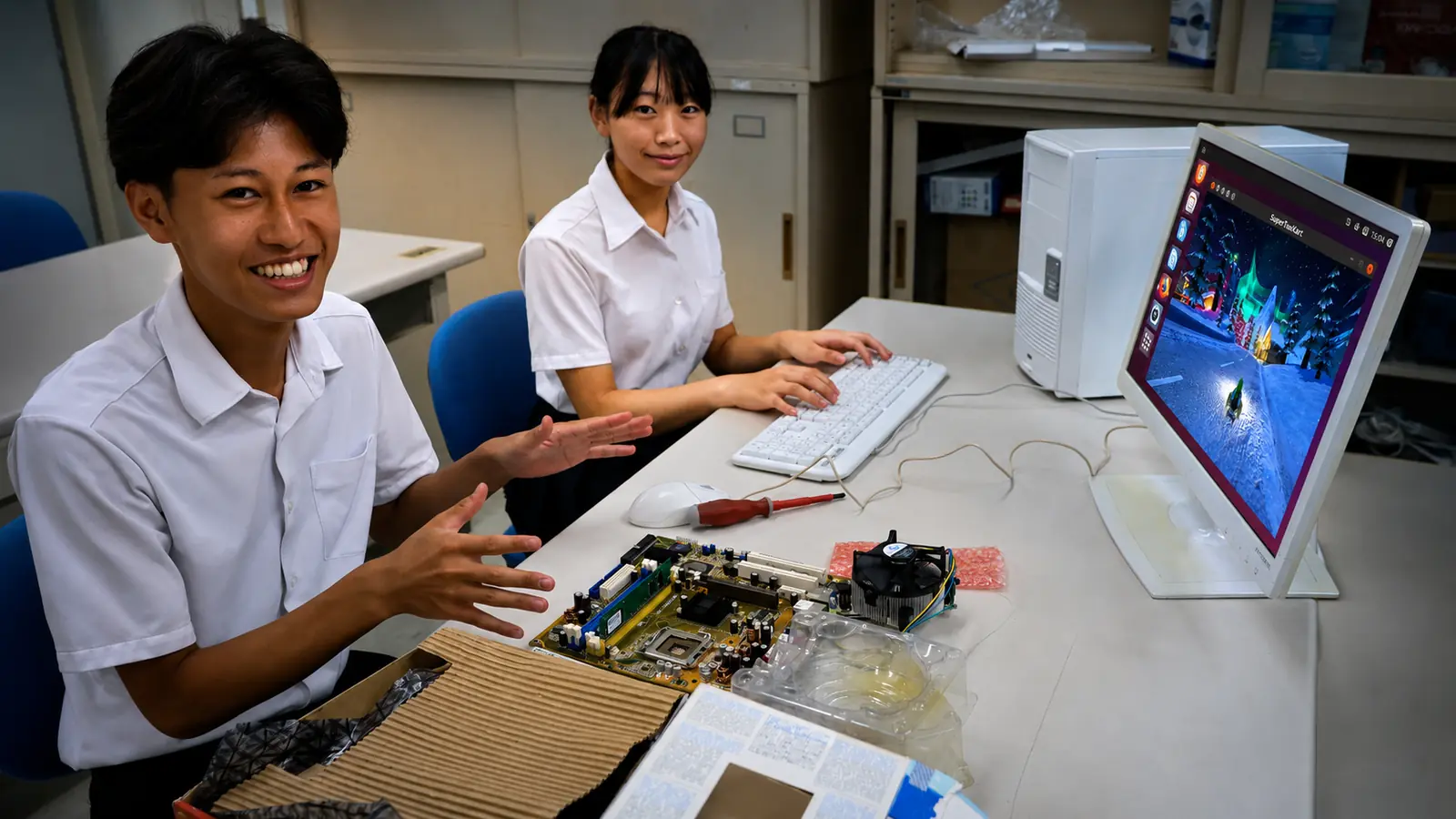
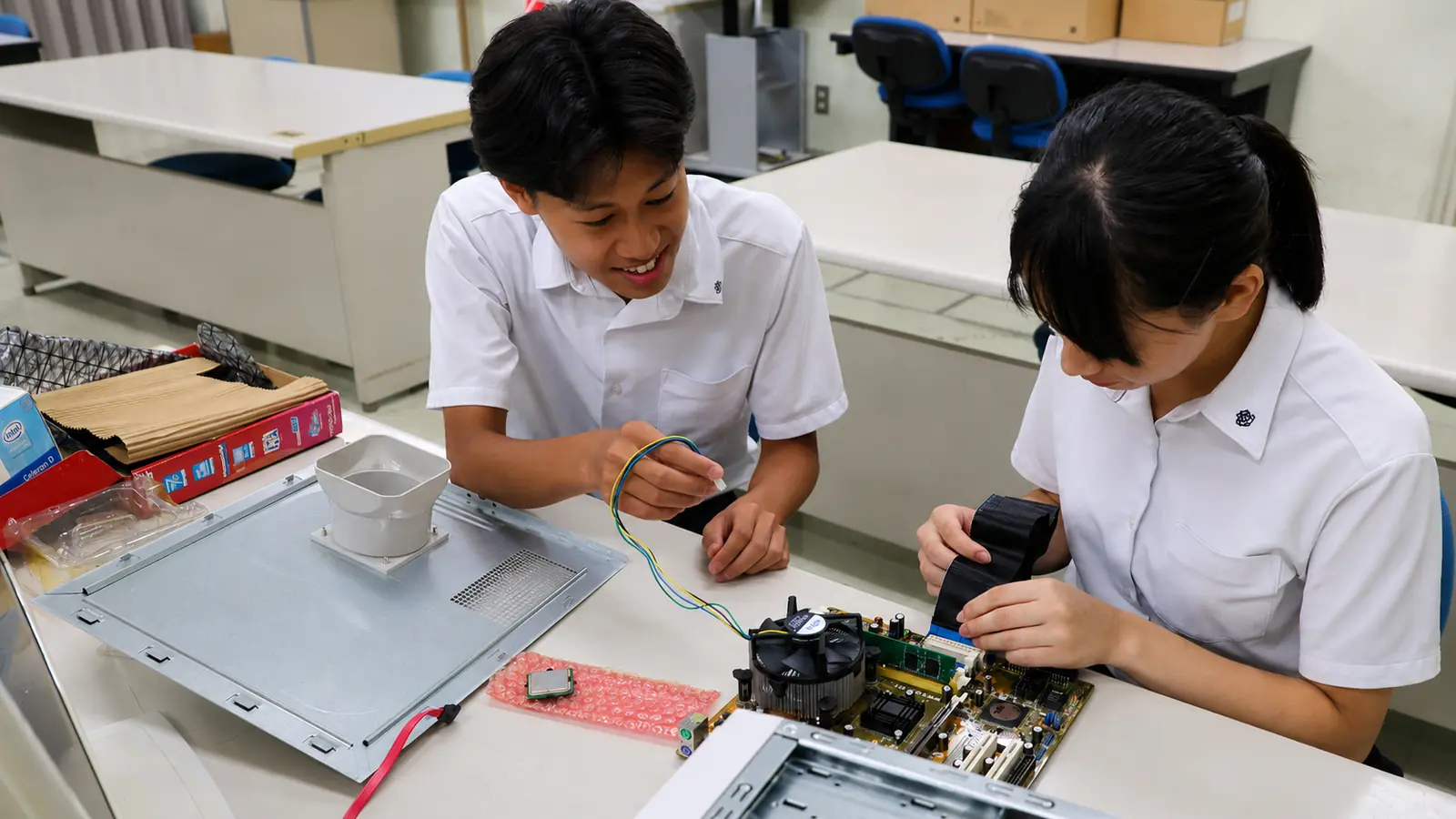
Students learn the roles of the CPU, memory, storage, power supply, electronic components and circuits, and take on PC building and electronics projects. They connect components and, when something doesn't work, check the wiring and settings one by one to find the cause.

AI and software also run on physical devices such as computers, sensors and power supplies. Understanding what's inside lets students choose the right equipment for the purpose, think about the causes of failures and malfunctions, and handle devices safely. This is the foundation for system development, manufacturing, maintenance and IT support.

Using programming, HTML, CSS and more, students create web pages and applications while considering screen readability, ease of operation and the order of information. Once finished, they improve them based on feedback from real users.

No matter how good a technology or piece of information is, it has no value if the people who need it cannot find it or don't know how to use it. By considering people of different ages, experience and devices, and designing so that anyone can use it easily, students learn the thinking behind information services that support businesses, government, education and communities.

Students create characters, animations, posters and more, working carefully with text, color, photos, motion and the order of information. They think about "who to tell, what, and how," and create expression that leads viewers to understand and act.

The appeal of a product or a tourist spot, disaster information, public services and learning content are useful only when they are not just correct but actually understood. Students learn design not as decoration but as a technology that connects people and information, building the ability to organize content and express it from the audience's point of view.

Working with the local community, universities and experts, students tackle problems that have no single answer. Listening to users and repeatedly researching, planning, producing, presenting, evaluating and improving, they complete one result together with teammates who have different strengths.

In the real world, products and services are made by people in different roles working together: engineers, designers, planners and users. By practicing communicating their ideas, listening to others, fulfilling their roles and improving from failure, students gain the collaborative skills to put their knowledge to use in society.

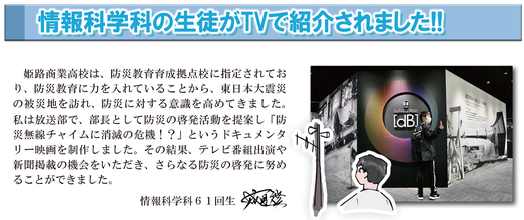
An article reporting that a disaster-preparedness documentary made by students was featured on TV and in newspapers

LEARNING THAT REACHES SOCIETY

Students' learning truly reached society.

Prompted by a visit to areas hit by the Great East Japan Earthquake and by disaster-preparedness lessons at school, students turned their attention to the threat that the chimes of disaster-prevention radio broadcasts might disappear, and produced the TV documentary "Disaster-Prevention Radio Chimes on the Verge of Disappearing!?"

Find a problemResearchInterviewFilm & editBroadcastSociety receives it

The work and the students' activities were featured on TV programs and in newspapers, prompting local residents to think about disaster preparedness. This is not just a story about awards or media coverage. It is a real example of learning that went from asking a question, to combining technology and expression, to making an impact on society.

Watch the TV documentary

04 / GROWTH & PATHWAYS

Learning that extends beyond the classroom

When you love something, you want to try just a little more. That curiosity becomes the ability to keep learning on your own.

Sparked by technologies they discover in class, more and more students keep researching, experimenting and creating on their own outside class hours, such as after school.

"I want to make it move exactly the way I want."
"I want to try another approach, too."
"I want to finish it as my own work."

These feelings lead to self-directed learning. The attitude and skills to go beyond reproducing what you were taught, to find the knowledge you need on your own, and to keep experimenting are a great strength in a society where technology never stops changing.

Five skills you gain in the Information Science Department

Interpret, create, run, and deliver to society.

Rather than stopping at knowledge, students build up three years of learning that runs from thinking with data to prototyping, improving and sharing their work with their teammates.

1

Understanding IT from how it worksProgramming, hardware, networks, AI, information security and more are understood by connecting them to hands-on practice.

2

Interpreting data and combining technologiesStudents collect, organize and analyze information to find trends and make evidence-based decisions, then combine the results with programs, devices, 3D, the web, design and more to create works and systems.

3

Thinking about users and businessThrough bookkeeping, accounting, cost accounting and business, students consider costs, products, users, sales and social value.

4

Problem solving through repeated prototyping and improvementFailure is not the end: students find the cause, try another approach, and improve toward something better.

5

Learning independently and delivering to society with teammatesStudents find the information they need on their own, work with teammates who have different strengths, and present their works and research clearly.

Pathways that open up beyond school

The specialist knowledge, qualifications, problem-solving skills, business perspective and communication skills gained in the Information Science Department lead to both further education and employment.

Further education

Students can go on to study information science, engineering, business management, education and more at university, or IT, design, music, business and more at vocational schools.

Employment

Students can aim for a wide range of careers, including systems engineer, programmer, IT support, manufacturing and technical roles, IT and administrative departments at companies, and public service.

By studying not only information technology but also accounting and business, students don't limit their future to a single field, and can broaden their options to match their own interests and goals.

05 / OUTCOMES

Outcomes: university admissions and national examinations

Ask questions, create, run, improve and deliver to society. That accumulation leads to solid career paths and foundational skills demonstrated by nationwide standards.

Three years of learning that lead to solid pathways

The Information Science Department is not just about learning job-ready skills and qualifications. By building both academic fundamentals in general subjects and specialized learning in IT, engineering and business, it develops the ability to go on to higher education, including national and public universities.

Information Science | 1 class 18 / 39 students went on to national or public universities Rate 46.2%
Commerce | 5 classes
18 / 196 students went on to national or public universities Rate 9.2%

Although the Information Science Department has one-fifth as many classes as the Commerce Department, the same number of students, 18, went on to national or public universities. In a simple comparison as a share of graduates, the Information Science Department's rate is about five times that of the Commerce Department.

The logical thinking, problem-solving and inquiry skills developed in specialized subjects are linked with academic ability in general subjects and career guidance to support each student's university goals.

* Results for graduates in spring 2026. Because each department differs in content and intended pathways, the percentages are a simple comparison using the number of graduates as the denominator. Results vary from year to year.

Systematic foundational skills that lead to national examinations

Students study programming, algorithms, hardware, networks, databases, information security, corporate activities, accounting and more, step by step.

These areas are closely linked to the fields covered by the national Fundamental Information Technology Engineer Examination. Rather than aiming only to earn qualifications, students understand how things work in class and verify it through hands-on practice, building the foundation needed to take on national examinations.

As of September 2026

National examinations passed by third-year students, 2026 school year

From a class of about 40 students 31 national examination passes in total

IT Passport Examination: 23 students.
More than half of the class has passed.

Knowledge and skills needed by IT engineers Fundamental Information Technology Engineer Examination 5 passed
Management and operations to protect an organization's information Information Security Management Examination 3 passed
Broad learning across IT, management and law IT Passport Examination 23 passed

Qualifications are not the goal, but a milestone on the way to the next stage of learning.

We don't make earning qualifications an end in itself. At the same time, confirming the skills gained in hands-on classes against a nationwide standard, and feeling one's own growth, is very meaningful. Passing becomes a new starting point for more specialized creation and inquiry.

This shows that it is not just a few students taking on qualifications, but that foundational IT skills have spread across the whole class, and from there, students are growing into specialized fields such as development and information security.

A major feature of the Information Science Department is that each student can take on progressively higher-level national examinations, from basic to specialized, according to their learning stage and career goals.

About 2.87 million high school students nationwide: how rare these passes are

According to the School Basic Survey for FY2025 by Japan's Ministry of Education, Culture, Sports, Science and Technology (MEXT), 2,873,619 students, roughly 2.87 million, are enrolled in high schools across Japan. Meanwhile, the number of high school students nationwide who passed the Information Technology Engineers Examinations in the same year was as follows.

Fundamental Information Technology Engineer Examination 1,032 passed (pass rate among examinees: 31.1%)

About 0.036% of all high school students, or roughly 1 in 2,800 per year

Information Security Management Examination 353 passed (pass rate among examinees: 49.5%)

About 0.012% of all high school students, or roughly 1 in 8,140 per year

IT Passport Examination 3,461 passed (pass rate among examinees: 24.9%)

About 0.12% of all high school students, or roughly 1 in 830 per year

By contrast, at our school, out of a class of about 40 students, 23 passed the IT Passport Examination, 5 passed the Fundamental Information Technology Engineer Examination, and 3 passed the Information Security Management Examination. Because national rankings by school are not published, we cannot rank ourselves, but this is a substantial record showing that foundational IT skills have spread across the whole class, and that a group of students is also advancing to more specialized examinations.

* Figures such as 0.12% are not "the percentage of high school students currently holding the qualification," but the number of high school students who passed during FY2025 as a share of all high school students nationwide. The total number of current high school students holding each qualification is not published, so these are not holding rates.

What you gain as a teenager: a head start on an IT career

IPA (Information-technology Promotion Agency, Japan) describes the Fundamental Information Technology Engineer Examination as "the gateway to becoming an IT engineer." The Information Technology Engineers Examinations also serve as a common benchmark for IT knowledge and skills, used not only for staff development at companies but also in hiring decisions, qualification allowances and one-time bonuses.

In addition, in IPA's "DX Trends 2025" report, 85.1% of Japanese companies reported a shortage of people to drive digital transformation. Not only IT companies but every sector, from manufacturing and retail to finance and government, needs people who understand and can use digital technology.

In this environment, passing a national examination while in high school is not a self-reported claim of having studied, but means being able to prove foundational IT skills against a nationwide standard before entering university or the workforce. The great value of passing as a teenager is that, instead of starting from the basics after entering university or a company, students can move on sooner to more practical learning in programming, AI, information security, system development and more.

Qualifications alone do not decide your future. However, by adding hands-on practice, creative work, problem solving and communication experience on top of the foundational knowledge proven by a qualification, students aiming for IT can begin building a specialized career earlier than their peers. Our pass record is not just a set of numbers; it is proof that students are broadening their options and possibilities for the future while still in their teens.

Sources (in Japanese): MEXT School Basic Survey FY2025 / IPA Fundamental Information Technology Engineer Examination statistics / IPA Information Security Management Examination statistics / IPA IT Passport Examination statistics / IPA Fundamental Information Technology Engineer Examination / IPA Use by companies and organizations / IPA DX Trends 2025

* Our school's figures show the number of passes for each examination; the same student may have passed more than one. National figures combine IPA's four high school categories (information, commerce, engineering, general, etc.).

Main qualifications students aim for

Information technology & engineering
IT Passport Examination / Information Security Management Examination / Fundamental Information Technology Engineer Examination / Applied Information Technology Engineer Examination / MOS (Microsoft Office Specialist)

Business
Information Processing Test / Practical Bookkeeping Test / Nissho Bookkeeping Test (Japan Chamber of Commerce) / Practical Business Calculation Test / Practical Business Document Test

To junior high school students

It's okay if you don't know much about computers right now.

The "Why?" you feel when you meet something you love.
The "I want to try" when you imagine how you'd make it.
That small question is the starting point of three years of learning.

The Information Science Department is not simply a place to become good with computers. It is a place to turn what you love into questions, explore how the world works with your own hands, connect different technologies and people, create new value, and deliver it to society.

From user to creator.
From creator to someone who delivers.

What you love becomes what you're good at.
What you're good at becomes your future path.

What we want to nurture here is not only technical skill.
"My ideas, too, have the power to help someone."
"By learning, I can shape my own future."
It is this sense of conviction.

11.6 FRI

OPEN HIGH SCHOOL

Event information

2026 Hyogo Prefectural Himeji Commercial High School
Open High School

On Friday, November 6, you can experience the Information Science Department firsthand. Please check the date and time, meeting place and activities.

Event & reception information

Date
Reception
Time
–
Meeting place
Gymnasium
Venue
Hyogo Prefectural Himeji Commercial High School
What to bring
Writing materials, indoor shoes
See "02 Digital Experience"

Application period: Thursday, October 1 – Monday, October 12, 2026 (public holiday)

02

Digital Experience

Connect ideas inside the computer to things that really move and works you can hold.

  • Computer-aided making, such as 3D printing
  • Hands-on robotics
  • A first taste of engineering
Optional activities

12:35–13:30 Cafeteria tasting
Optional, fee required

From 15:55 Club activity tours & PBL project exhibition
Optional